1. Where Machine Learning Genuinely Helps
Machine learning is strongest where there is a lot of data and a clear, measurable objective. In trading, that often means supporting decisions around a strategy rather than replacing it.
Proven uses of ML in trading systems
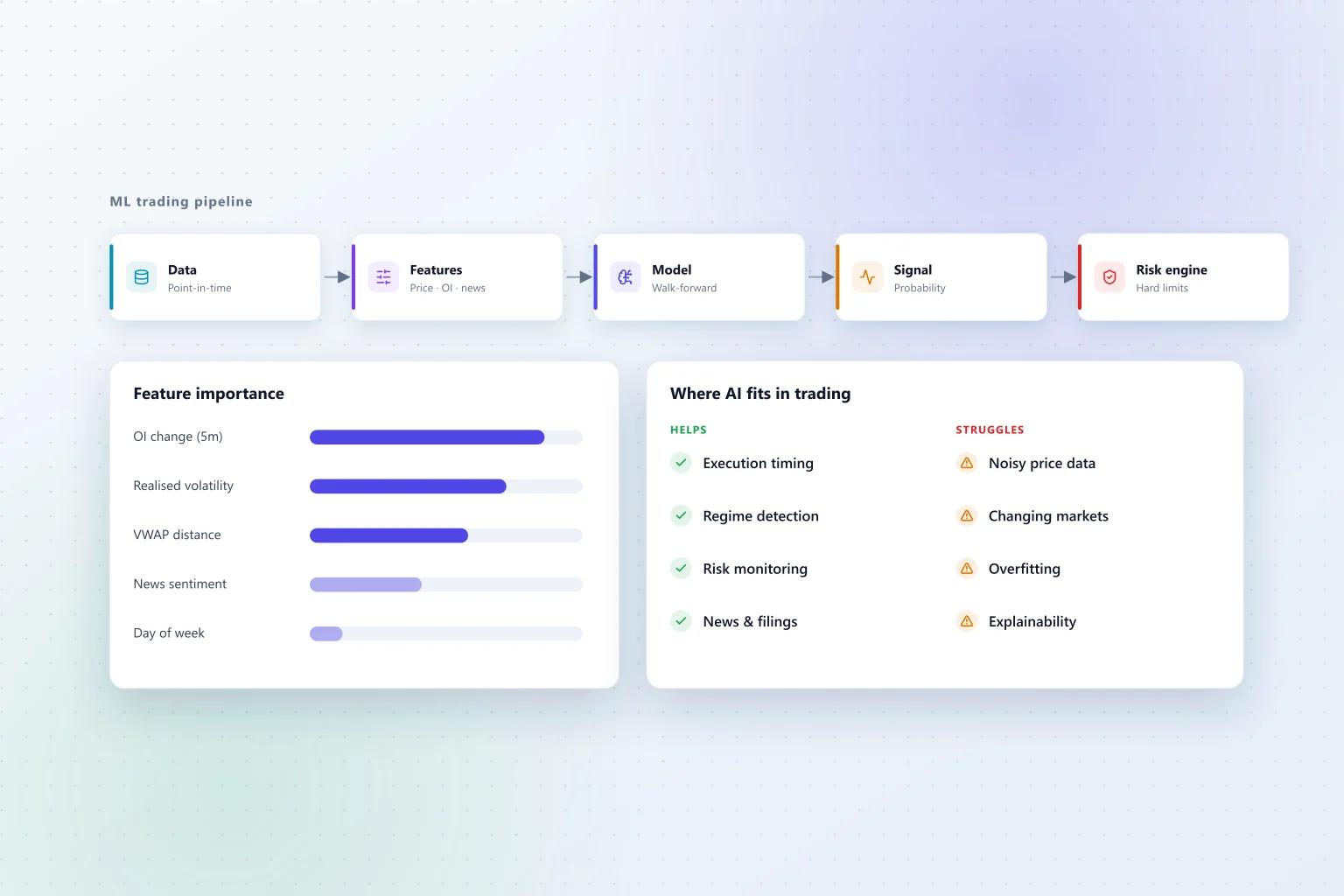
Execution optimisation: Predicting short-term liquidity and price impact to split and time large orders more efficiently.
Regime detection: Classifying markets as trending, ranging or volatile so strategies can adjust position size or switch off.
Feature research: Finding which combinations of indicators, volume and open interest data carry predictive information.
Risk and anomaly monitoring: Flagging unusual strategy behaviour, fills or data feeds before they cause losses.
Text analysis: Extracting sentiment and events from news, filings and earnings calls at a scale humans cannot match.
2. Where It Struggles
Financial markets are noisy and constantly changing. Patterns that held for years can disappear as other participants learn them, and the amount of genuinely predictive signal in price data is small compared with the noise.
This makes complex models especially prone to overfitting: they learn the noise in historical data and fail on new data. Many models are also hard to explain, which makes it difficult to trust them with capital or to review what went wrong after a bad day.
3. Large Language Models in Trading Workflows
Large language models are most useful as productivity tools for trading teams: summarising research and filings, answering questions over internal documentation, helping write and review strategy code, and generating first drafts of reports.
Letting a language model place trades on its own is a different matter. Its outputs can vary between runs and it can state incorrect facts with confidence, so any trading decision it influences should pass through the same rules-based risk checks as every other order.
4. Building a Trustworthy ML Trading Pipeline
The discipline around the model matters more than the model itself. A reliable pipeline treats every step, from data to deployment, as something to be tested and monitored.
Steps in a production ML trading pipeline
Clean, point-in-time data: Features built only from information available at each moment, with corporate actions handled correctly.
Clear labels: A precise definition of what the model predicts, such as the return over the next N bars after costs.
Walk-forward validation: Training on past windows and testing on the following ones, never on randomly shuffled data.
Simple baselines: Comparing every model with a simple rule-based strategy to prove the added complexity pays off.
Monitoring for drift: Tracking live predictions against outcomes and retraining or switching off when performance degrades.
5. Governance, Explainability and Compliance
Regulators and risk teams expect to understand why a system traded. Logging model inputs, outputs and versions for every decision, keeping models under version control, and preferring interpretable models where possible all make AI-assisted trading easier to review and defend.
AI components should always sit behind the same pre-trade risk engine as any other strategy, with hard limits that no model can override.
6. Conclusion
AI is a powerful addition to a trading system when it is applied to the right problems and wrapped in rigorous validation and risk control. It is not a shortcut to profitable strategies.
Accel Fintech builds algo trading platforms and AI-assisted analytics for traders and fintechs, with the data pipelines, validation and risk controls that make them dependable. If you are exploring AI in your trading workflow, we can help you scope a practical first project.